About Mission: Impossible II
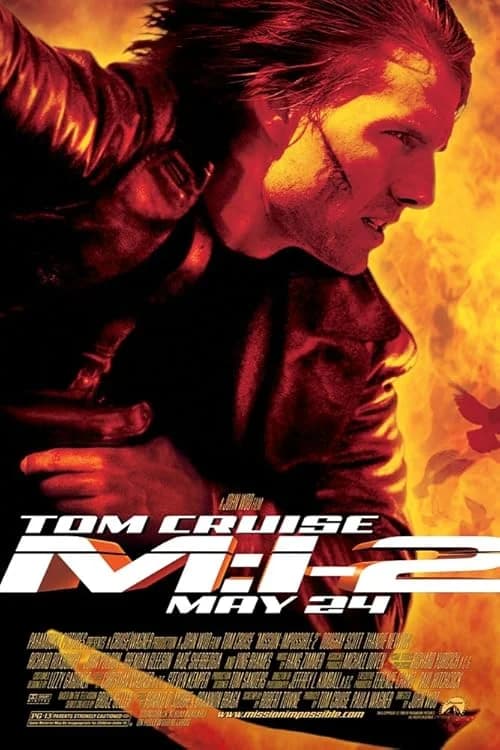
Mission: Impossible II (2000), directed by John Woo, represents a bold stylistic departure for the franchise, infusing the spy thriller formula with Hong Kong action cinema's signature flair. Tom Cruise returns as IMF agent Ethan Hunt, this time tasked with retrieving a deadly genetically engineered virus called Chimera and its antidote, Bellerophon, before rogue agent Sean Ambrose (Dougray Scott) can unleash it for profit. The film shifts from the first installment's intricate Cold War-inspired plotting to more visceral, character-driven stakes, emphasizing physicality, romance, and spectacle.
Woo's direction is immediately recognizable through slow-motion doves, dual-wielding gunfights, and highly choreographed combat that prioritizes balletic movement over gritty realism. While the plot is arguably simpler than its predecessor, it serves as an effective vehicle for breathtaking set pieces, most notably the iconic rock-climbing opener and the final motorcycle duel. Cruise performs many of his own stunts with characteristic commitment, and Thandie Newton brings emotional depth as thief Nyah Nordoff-Hall, whose complicated relationship with Hunt adds personal stakes to the global threat.
Though sometimes criticized for its heightened style and melodrama compared to other series entries, Mission: Impossible II is essential viewing for action enthusiasts and franchise completists. It showcases a unique vision within the series—one where elegance and excess collide—and solidified the franchise's willingness to reinvent itself with each director's touch. For a dose of early-2000s action bravado with unforgettable imagery, this chapter remains a thrilling, if distinct, ride in Ethan Hunt's impossible missions.
Woo's direction is immediately recognizable through slow-motion doves, dual-wielding gunfights, and highly choreographed combat that prioritizes balletic movement over gritty realism. While the plot is arguably simpler than its predecessor, it serves as an effective vehicle for breathtaking set pieces, most notably the iconic rock-climbing opener and the final motorcycle duel. Cruise performs many of his own stunts with characteristic commitment, and Thandie Newton brings emotional depth as thief Nyah Nordoff-Hall, whose complicated relationship with Hunt adds personal stakes to the global threat.
Though sometimes criticized for its heightened style and melodrama compared to other series entries, Mission: Impossible II is essential viewing for action enthusiasts and franchise completists. It showcases a unique vision within the series—one where elegance and excess collide—and solidified the franchise's willingness to reinvent itself with each director's touch. For a dose of early-2000s action bravado with unforgettable imagery, this chapter remains a thrilling, if distinct, ride in Ethan Hunt's impossible missions.